The Photos That Outlasted the Lease
In October 2014, I walked into a dessert bar in San Diego to shoot it for the client who designed it. But here’s the thing… the restaurant had already closed. He knew it was closing weeks before he called me, and he had to wait until it was shuttered to bring me in.
“I just want a record of what we did,” he told me.
The hero shot from that shoot, the one I’d normally use as the opening image on the project page, has a “space for lease” sign hanging in the front window. I didn’t plan that. It was just what was there. I shot it anyway, because that was the assignment. Not “make it look open.” Make sure there’s an accurate record of what this was.
That restaurant was called Swoon. It’s the only one of the three I’m writing about here that I photographed after it had already closed. The other two, I shot while they were still open, still hopeful, still mid-run. All three are gone now. All three were designed by the same small firm, since dissolved. And all three taught me something about what I’m actually being hired to do, which isn’t quite what I used to think it was.
Three Bets, Three Losses
Swoon was a dessert bar in North Park, one of San Diego’s original “hipster” pockets. It was housed on a stretch that had already burned through a few concepts before it, there was tight parking, a CVS next door with a “spicy” crowd, and a high homeless population in the immediate area. It was open for less than a year.
Sababa Kitchen, a Mediterranean takeout spot in North County San Diego, had its own uphill climb before it ever opened. I remember hearing they had some inspection struggles, and even had to demolish part of the finished restaurant floor before opening, which delayed their progress even more. By the time I shot it in April 2017, the place was finally running. It closed within two years.
Zymology 21 was the most ambitious of the three, a mad-scientist-themed bar in the Gaslamp Quarter, right next to Cafe 21, a restaurant from the same ownership group that had been running for years. Zymology had real money, leadership, and strategy behind it. They sourced large Erlenmeyer flasks and beakers as bar props, a magnetic stirrer used to make bespoke cocktails, dry ice, chemical formulas and molecular diagrams worked into the design, vivid teal tile and scientist portrait murals, a copper bar top, a caged liquor display suspended over the whole room. It’s probably the most visually striking bar I’ve ever shot. It lasted about 18 months.
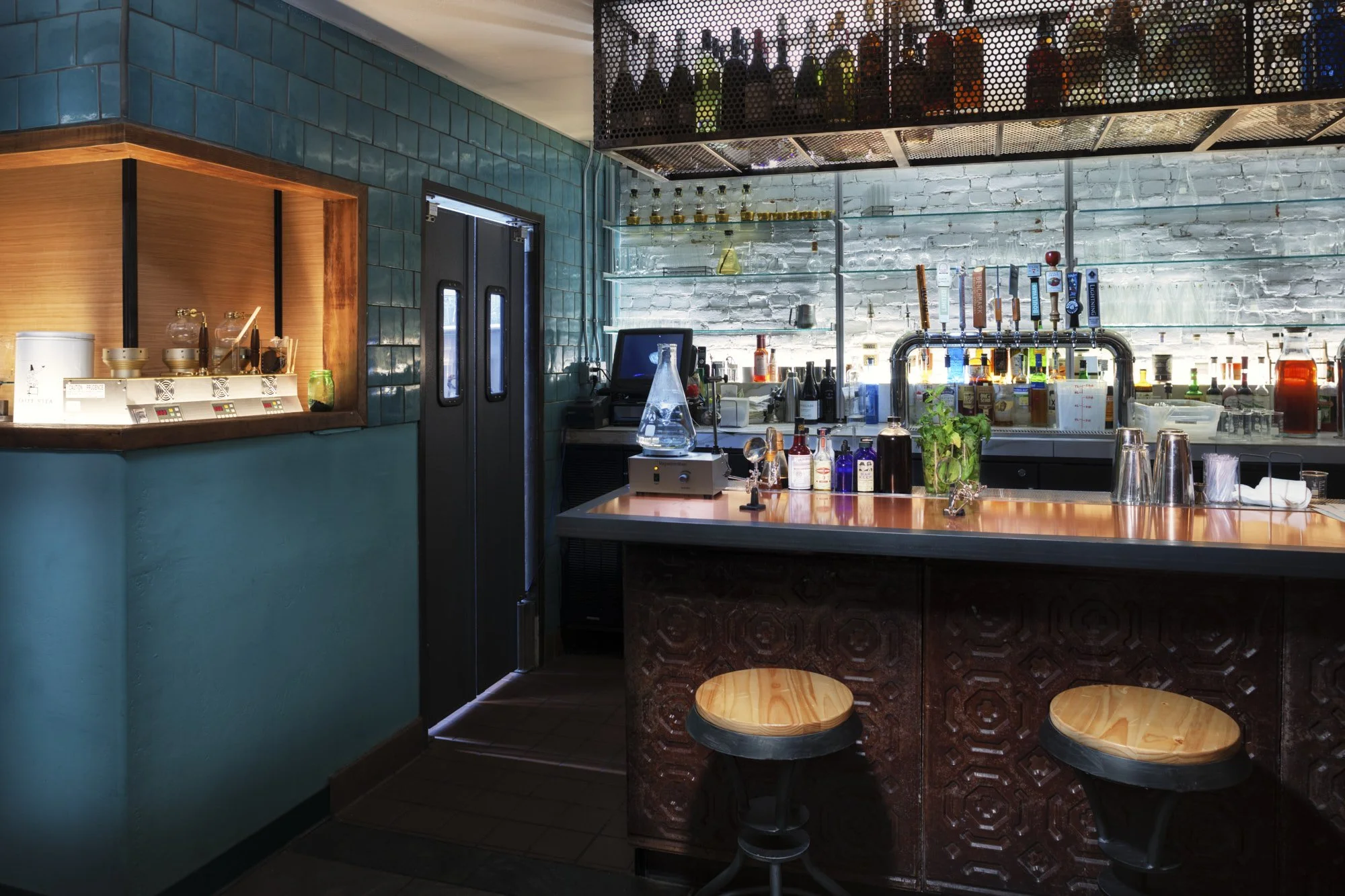
Zymology 21 in the Gaslamp District of San Diego, 2017
None of these were underfunded ideas that ran out of steam too early. They were real concepts, real investment, real design work, in real hopping locations their owners believed in. And none of them made it.
This Is More Normal Than It Feels
The “90% of restaurants fail in their first year” line gets repeated constantly, and it isn’t true. It seems to trace back to an early-2000s TV commercial with no research behind it at all. The real number, from research covering nearly two decades of Bureau of Labor Statistics data, puts first-year restaurant failure closer to 17%, with the National Restaurant Association’s own estimate running somewhat higher, around 30%.
But the average masks something more specific and, for my clients, more relevant: Concept-driven, capital-heavy restaurants fail at meaningfully higher rates than simpler ones. Fine dining restaurants had roughly a 4.9% first-year failure rate in 2025, compared to about 0.5% for fast casual concepts, a gap tied directly to how much capital and creative risk the ambitious end of the business takes on.
San Diego right now is a good example of exactly that tension. A November 2025 survey found that 72% of restaurants across San Diego County reported customer traffic down in 2024 and 2025 compared to prior years, out of nearly 11,600 restaurants countywide. And yet more than 70 bars and restaurants closed across San Diego in 2025, in the middle of one of the most aggressive expansion cycles the city has seen in years. It’s not a dying market. It’s a brutally competitive one, where people keep placing major bets, and a lot of those bets don’t pay off, regardless of how good the concept was.
I’m a simple unfrozen caveman photographer. I don’t have hard financial data on Swoon, Sababa, or Zymology 21 specifically, but I don’t need it. I have three real examples and some real numbers showing they’re not outliers.
What I’m Actually Hired to Do
Most of my hospitality clients are entrepreneurs. Hiring a photographer is one more bet layered on top of everything else they’re already risking: buildout cost, the lease, the staff, the concept itself. They’re trusting that my images will represent the vision they and their designers built, that the work will fit into a marketing or social strategy that, in a lot of cases, doesn’t fully exist yet. That’s real money, spent on faith and a gut feeling that sometimes goes against market research.
For a long time I thought of that work as documentation of a beginning. The launch. The best the space would ever look. I still believe that’s true, the shoot really is the place at its absolute best, before wear and scuffs and spills, before the crowd changes the room, before anything goes wrong.
But Swoon changed how I think about it. Sometimes the photos aren’t a record of a beginning. Sometimes they're the only record, period. If nobody had hired me to photograph Swoon, Sababa, or Zymology 21, there would be almost nothing left to prove any of them existed the way their owners built them, not the tilework, not the flasks on the bar, not the sad “for lease” sign in a window.
I don’t get to decide whether a restaurant survives. That was never the job. The job is making sure that whatever happens next, there’s a real, well-made account of what someone built, and what it looked like the day it mattered most. Sometimes that’s opening day.
Once, it was the day it closed.