A Day in the Life: Shooting Construction Progress (Part 2—Reading a Job Site Before I Fly)
My drone kept flying home.
I had a pre-plotted flight path set up for monthly progress shots at Goldfinch at Mulberry Gardens, an affordable senior housing project in Riverside I’ve been documenting for Allgire General Contractors, on behalf of Eden Housing. Same route every month, so the shots stay comparable over time. Except this one visit, the drone kept aborting partway through and heading “home” (my initial launch spot). No warning, no obvious cause. I checked the batteries, the GPS signal, the drone firmware and flight software. Everything seemed normal.
It took me a little while to figure out what was actually happening: Heavy-duty power lines running along the far edge of the site were throwing off enough RF interference to break the connection every time the drone got close. Not a malfunction. Not weather. Just one specific, physical area of the site that the drone couldn’t fly cleanly.
The fix was almost embarrassingly simple once I understood the problem.
I hoofed it.
As the drone moved through that section of the route, I moved with it, staying close enough to hold the connection, basically jogging under my own flight path until it cleared the interference zone.
That’s the kind of thing you only learn by being on-site and paying attention. And it’s why, before I ever get a drone in the air on a construction site, I’m doing a full walk of the property first.
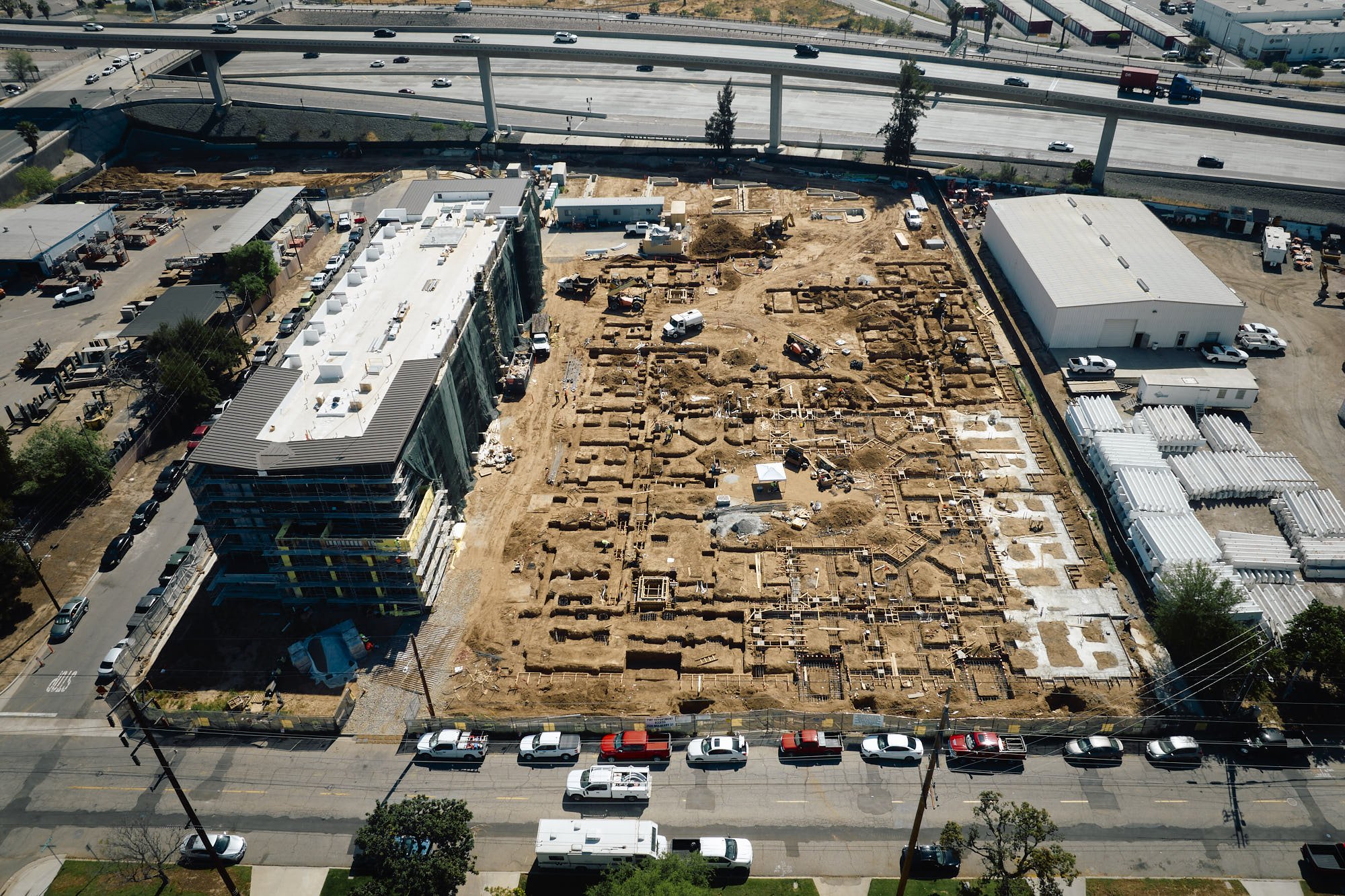
Goldfinch at Mulberry Gardens
I’m looking at the ground. Where are the trenches? Where are the materials and trash staged? Where’s the site trailer so I can check in before I start? Where are temp power poles and breakout boxes? I don’t want to trip over them while I’m looking everywhere other than down at my feet.
Tall trees do double duty as obstacles and RF absorbers. Dense foliage eats a wireless signal even more effectively than a power line does. High-tension transmission lines are a physical hazard and a major RF emitter, as I experienced at my Riverside site. Occasionally, there are overhead structures—the Goldfinch project features a bonus freeway overpass, which complicates my flight paths.
If there’s a crane and/or a concrete pump active on site that day, I try to talk to the operator before I fly anywhere near it. Not because I need permission, exactly, but because someone running a boom fifty feet in the air deserves to know there’s a drone in the airspace they’re occupying, and I’d rather have that conversation on the ground than shouting (if you’ve never been to a jobsite, it’s a very shouty place) at somebody while I’m in the air.
None of this is “official” stuff like paperwork or permission. It’s just looking closely at a specific piece of ground before deciding it’s safe to fly over it. The FAA rules tell me what’s legal. They don’t tell me where the power lines are going to mess with my signal, or which area has bad line-of-sight. That part, I only learn by walking it myself, every time, no matter how many times I’ve flown the same route.
Reading the site is half the job. Staying safe once you're actually standing in it, boots, blind spots, and all, is the other half. That’s next.